
News


Upcoming Event at IZO

Recent activities




Search for all News
IZO Events


IZO Events

Dr. Volker Stanzel (Stiftung Wissenschaft und Politik, ehem. Botschafter der BR Deutschland in der VR China und Japan)
MdB Omid Nouripour (Vizepräsident des Deutschen Bundestages, Mitglied im Auswärtigen Ausschuss und Berichterstatter der Grünen Bundestagsfraktion für China)
Prof. Dr. Björn Alpermann (Julius-Maximilians-Universität Würzburg, Contemporary Chinese Studies)
Prof. Dr. Iwo Amelung (Goethe-Universität Frankfurt am Main, Sinologie)
Ort: Campus Westend, Casino, Nina-Rubinstein-Weg 1, 60323 Frankfurt am Main
IZO Events

Current Research

This publication explores how Koreans in the Global South create new pathways of integration and opportunity within diverse political and economic contexts. Drawing on empirical case studies, it shows how migrants navigate local conditions and reshape conventional understandings of mobility and identity. The volume argues that Korean migration to the Global South is a significant yet understudied dimension of contemporary migration that calls for new theoretical perspectives on global mobility.
Link to the anthology:
https://www.bloomsbury.com/us/korean-migration-and-mobility-in-the-global-south-9781666963809
Contributors/Authors: Yonson Ahn, Jihye Kim, Carolyn Choi, Dennis Woohyuk Choi, Jinok Choi, Sergio Gallardo García, K. C. Ho, Gaik Cheng Khoo, Jeehun Kim, Jihye Kim, Young Su Park, Hae Young Yun
MA Modern East Asian Studies

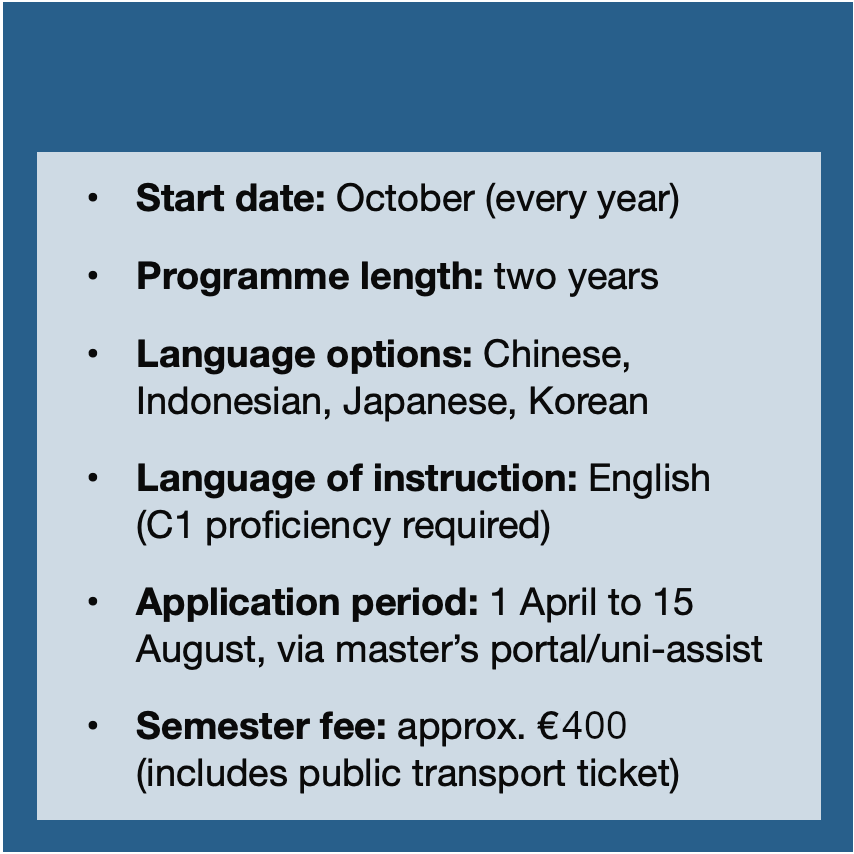
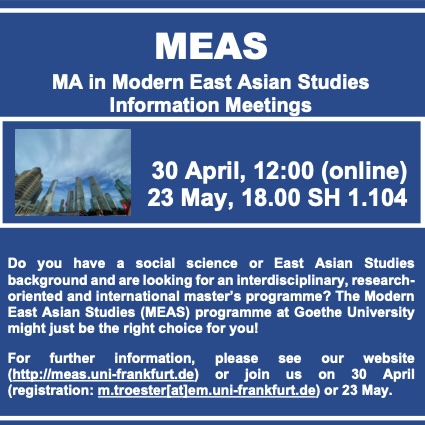
An online meeting for students interested in the MA programme Modern East Asian Studies (MEAS) will be held on 13 MAy, 12:00 (CEST). If you plan to attend, please register via Zoom. A second information session will be held in person (SH 0.107) on 3 June, 4-6 pm.
The application portal opens on 1 Apriland closes on 15 August. If you did your BA abroad, we strongly recommend applying by 15 July at the very latest.
More information about admissions and the programme: Admissions section of the MEAS website.
IZO Events

The talk argues that entrepreneurship has evolved from an economic activity into a broader ideology shaping how people interpret uncertainty, responsibility, and inequality. Drawing on institutional theory, it shows how this shift reflects changing economic structures and now influences domains like work and technology.
About the speaker:
Robert N. Eberhart is an associate professor at the University of San Diego's Knauss School of Business, specializing in entrepreneurship, institutional change, and firm dynamics. He holds a PhD from Stanford and has published in leading journals such as Organization Science and Strategic Management Journal.
About the lecture series Asia on the Move:
When humans migrate, they carry along their pasts, languages, sentiments, stories, and dreams. In our post-national world increasingly connected by digital technologies, national identities continue to function as “works of imagination” (Appadurai) that give individuals a sense of belonging. Asia, one of the most dynamic regions in the global flux of people, goods, and services, stands in the focus of this lecture series. In six lectures spanning across two semesters, this series promotes interdisciplinary perspectives to studying the mobility of people, memories, and imaginations across and beyond Asia.
IZO Events

IZO Events

The Isaan Record, a Thai media outlet, has spent over three years following the fate of people from the country's Northeast (Isaan) who traveled to work as berry pickers in the forests of Finland and Sweden. Believing that this work opportunity would give them an income boost to help them pay off debts, these workers borrowed money to pay brokers who arranged their applications. The work seemed a safe bet, as the Ministry of Labor was involved.
However, fate did not smile upon them; they were deceived into working for free and fell victim to human trafficking. After three months of work, some returned home empty-handed, now in even greater debt. Over the years, reports indicate that over 4,000 Thai workers have fallen victim to the scheme, prompting them to rise up to demand justice.
Thai state agencies and the Finnish and Swedish governments have been slow to act. But a Finnish court in Lappland found company representatives guilty of human trafficking earlier this year. Despite the ruling and an investigation into the former Minister of Labor's role in the scheme, that very same politician was promoted to Deputy Prime Minister in September this year. This story is ongoing. Will those responsible for abuse be held responsible? Will the victims of the scheme find justice or compensation?
About the speaker:
Hathairat Phaholtap is the director of the documentary “Blood Berries." She has been a journalist since 2003. She moved through print media positions until becoming a producer and investigative reporter at the Thai Public Broadcasting Service (Thai PBS) where she focused on politics, women, and human rights. Hathairat has served as the editor-in-chief of The Isaan Record, a regional news outlet of Northeast Thailand since 2019. She has recently published a book on her experiences at the hands of security forces in Thailand, Before Becoming a Journalist on the Information Operations Watchlist.
About the lecture series Asia on the Move:
When humans migrate, they carry along their pasts, languages, sentiments, stories, and dreams. In our post-national world increasingly connected by digital technologies, national identities continue to function as “works of imagination" (Appadurai) that give individuals a sense of belonging. Asia, one of the most dynamic regions in the global flux of people, goods, and services, stands in the focus of this lecture series. In six lectures spanning across two semesters, this series promotes interdisciplinary perspectives to studying the mobility of people, memories, and imaginations across and beyond Asia.
IZO Events

This talk will introduce the methods of critical analysis of video games and offer a survey of the cultural significance of the themes of identity and memory in contemporary videogames made in China and Taiwan. Videogame criticism is an emerging field that has not yet been fully constituted, in large part because game studies has wanted to resist the influence of literary and film criticism. I will distinguish videogame criticism from empirical, communications, and popular culture approaches to games. A critical approach to video games places their design elements in cultural, theoretical, and historical contexts in order to explore how videogames can make new points of view articulable.
After introducing this method for studying games, I will argue that a desire to represent Chinese cultures through videogames characterizes contemporary game design in China and Taiwan. I will focus on three games, Black Myth: Wukong (2024), which is China’s first “triple-A” popular game and a self-styled continuation of the classic 16th-century novel Journey to the West, Taiwanese studio Red Candle’s “taopunk” Nine Sols (2024), and Chinese developer Shiying Studio’s nostalgic Firework (2021). References to Chinese folklore, often embodied by ghosts, permeate Chinese and Sinophone games. These games seek to naturalize an essential, unchangeable Chinese cultural identity through the recollection of local histories, but instead call into question how Chinese culture is defined and where its boundaries lie. Staking out a position between accepting this form of cultural memory as natural and dismissing it as socially constructed, I conclude that the desire for these games to define themselves as Chinese itself constitutes their Chineseness. The recurring desire for a singular Chinese cultural identity in Chinese and Sinophone videogames upsets the field of Sinophone studies’ longstanding focus on divergent and local articulations of Chineseness.
About the speaker:
Michael O'Krent is Vertretungsprofessor in the Department of Sinology at Goethe University Frankfurt and a Postdoctoral Researcher at the University of Basel. He holds a PhD in Comparative Literature from Harvard University. His work on science fiction and videogames in both Chinese and global contexts has been published widely in venues including the Journal of World Literature, Prism, and Science Fiction Studies.
About the lecture series Asia on the Move:
When humans migrate, they carry along their pasts, languages, sentiments, stories, and dreams. In our post-national world increasingly connected by digital technologies, national identities continue to function as “works of imagination” (Appadurai) that give individuals a sense of belonging. Asia, one of the most dynamic regions in the global flux of people, goods, and services, stands in the focus of this lecture series. In six lectures spanning across two semesters, this series promotes interdisciplinary perspectives to studying the mobility of people, memories, and imaginations across and beyond Asia.