25 September 2025, Frankfurt
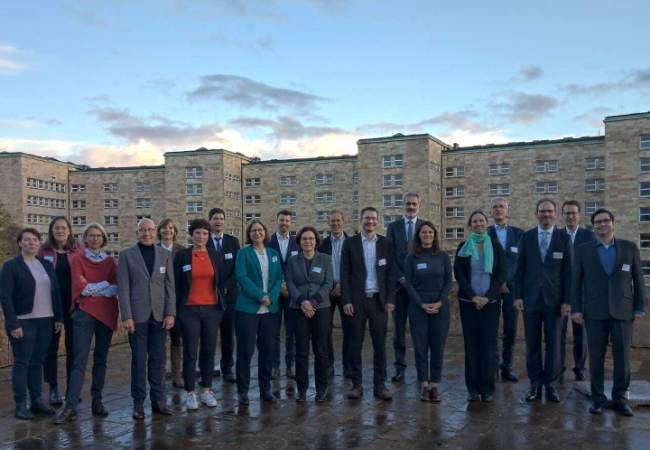
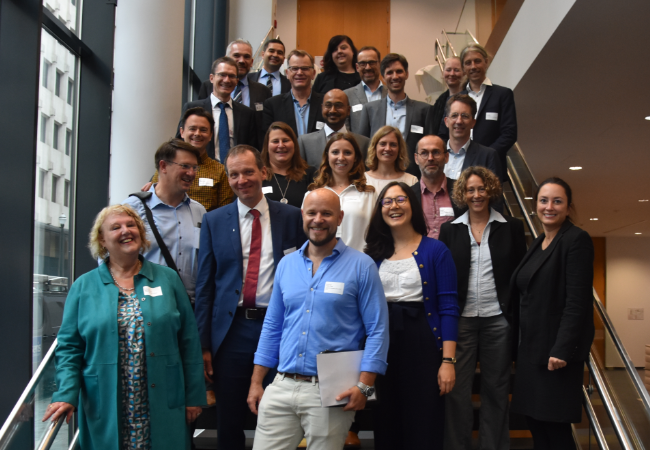
As part of the Mercator Science-Policy Fellowship Programme and the ENGAGEgreen project, Goethe University Frankfurt organised its fourth meeting of colleagues from Rhine-Main universities and non-university scientific institutions in the Rhine-Main area who deal with the topic of transfer in politics and administration.
20 May 2025, Mainz
Image rights:
Stefan Saemmer (top)
Peter Pulkowski (bottom)
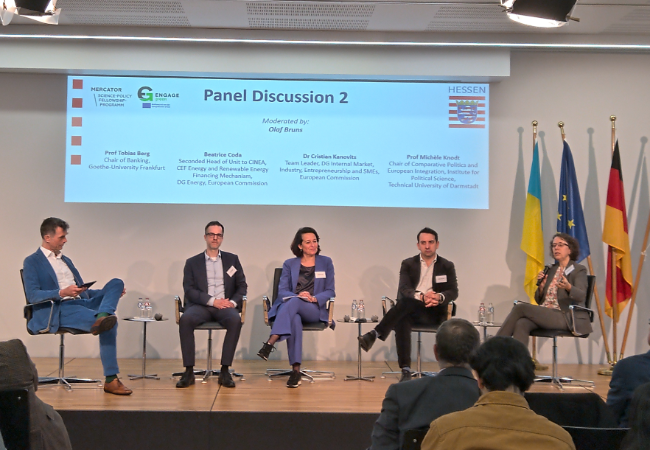
The ENGAGEgreen project and Mercator Science-Policy Fellowship-Programme co-organised the international conference “Science Communication as Knowledge Transfer” in cooperation with Johannes Gutenberg-University Mainz, the Rhine-Main-Universities, the European University Alliance ForThem, and the Horizon project “Co-Creating the EU Competence Centre for Science Communication (COALESCE)” on 20 May 2025.
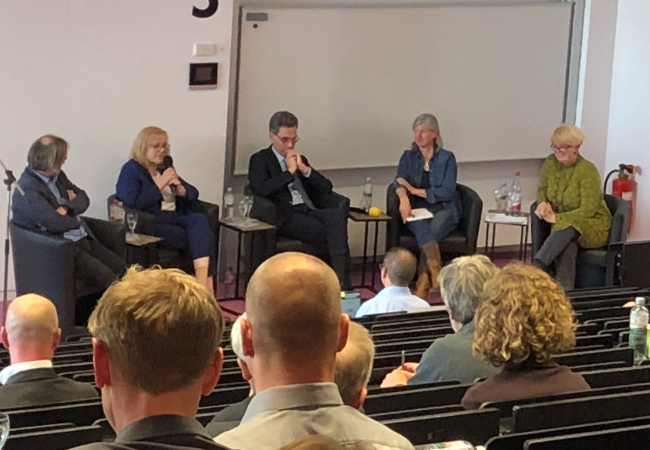
Tome Sandevski moderated the panel discussion “What is knowledge transfer? On the role of Science Communciation, Science Policy and the Notion of Transfer in Academia”. Professor Elena Link (Johannes Gutenberg University Mainz), Dr Patrick Honecker (Chief Communication Officer at TU Darmstadt), Professor Jason Pridmore (Erasmus University Rotterdam) and Dr Mario Scharfbillig (Joint Research Centre/European Commission) debated various approaches and issues regarding science communication.
Dr Simone Haasler and Tome Sandevski provided an overview on the ENGAGEgreen project and the policy dialogue formats of the Rhine-Main-Universities in two pitches. Tome Sandevski conducted a workhop on policy engagement for researchers and research managers in the afternoon.
The programme of the conference is available here.
16 May 2025, Webinar
Tome Sandevski organised a webinar for science managers and knowledge exchange officers for the FORTRAMA network on 16 May 2025. The webinar presented key lessons learned from the ENGAGEgreen project and the Mercator Science-Policy Fellowship-Programme. Regarding policy engagement researchers are often only familiar with time-consuming formats such as commissioned research or participation in expert bodies. Research managers and and knowledge exchange officers can support the policy engagement of scientists by informing researchers about the range of possible (time-efficient) knowledge exchange formats and/or supporting them in planning and implementing various knowledge exchange formats. The webinar provided an overview of written (e.g., policy briefs, contract research/longer studies) and dialogue-oriented transfer formats (e.g., workshop formats, visits to research institutions, expert discussions) as well as an overview on how to integrate them into the everyday work of research managers and researchers.
13 February 2025, virtual workshop
12 December 2024, virtual/Berlin
Tome Sandevski presented an overview of various types of science-policy dialogue schemes for the general partner meeting of the AI FORA project (artificial intelligence for assessment) on 12 December 2024.
On the same day, he participated in a workshop on science in parliament at the annual science communication conference in Berlin, followed by a presentation on science communication for policymakers.
29 November 2024, Frankfurt
Tome Sandevski conducted a workshop for 13 early career researchers, science communication, and policy engagement officers at the Rhine-Main-Universities and the Institute for Social-Ecological Research (ISOE) in Frankfurt.
The first part of the workshop provided an overview of policymaking processes, scientists' self-understanding, and written and interactive formats of policy engagement.
Experts from academia and policymaking joined the second part of the workshop. Dr Lukas Herr (policy advisor of the parliamentary group of the SPD in the regional parliament in Rhineland-Palatinate and policy fellow at the Rhine-Main-Universities), Priska Hinz (former MP and minister of environment in the state of Hessen and member of the advisory board of the Mercator Science-Policy Fellowship-Programme), Niklas Götz (Scientists for Future) and Dr. Vincent Lindner (Leibniz Institute for Financial Research SAFE) discussed their experience in terms of policy engagement.
21/22 November 2024, Bonn
Tome Sandevski presented the interim results of the Erasmus+ ENGAGEgreen project at a conference of the German Academic Exchange Service in Bonn. The record of the project is as follows:
We are looking forward to conducting transnational science-policy dialogue formats, publishing our policy engagement toolkit, and organising numerous training events in 2025.
19 November 2024, Berlin
Tome Sandevski had the chance to give presentations on policy engagement in Berlin on 19 November 2024. He gave the first presentation at the 11th network conference, which focused on the issue of scientific advice for policy.
The second presentation took place at a workshop at the Federal Ministry of Education and Research (BMBF), which was organised by the government's initiative on science communication (#FactoryWisskom) task force on policy engagement. The workshops focused on how networks can promote policy engagement. Tome Sandevski elaborated on the ENGAGEgreen approach of piloting science-policy dialogue initiatives, knowledge sharing among the eight ENGAGEgreen partners in five EU countries, developing a policy engagement tookit, and the capacity building and dissemination measures. His presentation was followed by a presentation by Sarah Chaytor (University College London) who presented the networks Universities Policy Engagement Network (UPEN) und Capabilities in Academic Policy Engagement (CAPE). About 20 representatives of the Federal Ministry of Education and Research, various universities, the Leopoldina, the German U15, Helmholtz Alliance and other organisations participated in the workshop. Our policy fellows Dr Maximilian Müller-Härlin (Federal Ministry of Education and Research) and Dr Friederike Schröder (German U15) participated in the workshop.
19 November 2024, Frankfurt
The ATHENE National Research Center for Applied Cybersecurity organised a conference on cognitive security in Frankfurt on 19 November 2024. Scientists, policymakers, and journalists discussed the issues of disinformation campaigns and cyber attacks. Our policy fellows Helga Schmidt (ARD studio Brussels) and Wulf Schmiese (ZDF) participated in the panel on the effects of disinformation campaigns on media.
The programme can be found here.
11 November 2024, Frankfurt/Rhine-Main
The two fellowship programs cooperated with the Research Institute on Social Cohesion (FGZ). Thus, researchers outside the Rhine-Main area also participated in the meetings.
In the evening, Prof Rainer Forst (Political Theory and Philosophy/Goethe University Frankfurt) introduced the Research Institute on Social Cohesion. This part was followed by a panel discussion on uncertainty in times of crisis. The panel included policy fellows Bobby Cherian (ZDF) and Dr Christina Herkommer (Federal Ministry for Family Affairs, Senior Citizens, Women and Youth) as well as Professors Sascha Dickel (Media Sociology/Johannes Gutenberg University Mainz), Nina Janich (German Studies/TU Darmstadt) and Stephan Lessenich (Social Theory and Social Research/Institute for Social Research and Goethe University Frankfurt). The evening event was moderated by Rebecca Schmidt (Research Institute for the Social Mote in German Society, Goethe University Frankfurt). The discussion focused on the break-up of the governing coalition in Germany, which had taken place just a few days earlier, ways of strengthening democracy, and the role of the media.
September/October 2024
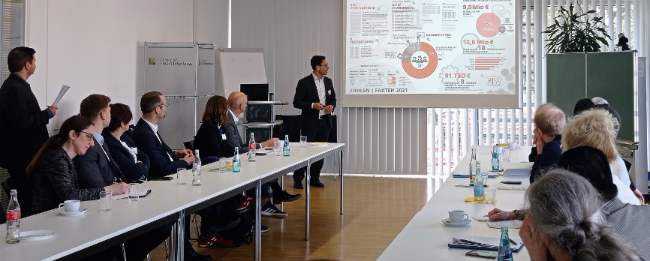
46 researchers from the Rhine-Main Universities of Darmstadt, Frankfurt and Mainz visited 16 political institutions in the state capitals of Hesse and Rhineland-Palatinate in September and October 2024. The researchers conducted 78 interviews with 101 political decision-makers in Mainz and Wiesbaden. The meetings took the form of 1:1 discussions or meetings in small groups. The meetings covered a wide range of topics, including environmental hazards from chemicals, mobility, digitalisation in schools, communication of environmental issues, the potential of AI for public administration and many other policy issues.
Summer 2024, Frankfurt
Krista Sager and Marlehn Thieme, who have been members of the advisory board of the Mercator Science-Policy Fellowship Programme since 2016 and 2018, respectively, left the board in 2024. Priska Hinz joined the board in the summer of 2024. Ms Hinz has experience of more than 40 years in policymaking. She served as a minister of environment in the State of Hessen between 2014 and 2024. Prior to becoming minister, she was a member of the German Bundestag, the regional parliament in Hessen, and head of the Green faction in the regional parliament in Hessen. She also held various positions on the local level.
June 2024
In June 2024 the fellows of the cohort 2023/24 visited the Rhine-Main-Universities for their second round of meetings.
28 Mai 2024, Mainz
meetings. There is great potential here for scientific institutions! The pilot project was a success and we are looking forward to the next round of the Rhine-Main Science Dialogue in September 2024!
Photo: Lunch with some of the participants at the State Chancellery of Rhineland-Palatinate
18 March 2024, Berlin
In a fishbowl discussion on 'The Communication Code: Shaping dialogue with politics and administration', Tome Sandevski (Goethe University Frankfurt) presented the policy fellowship programmes of the Rhine-Main universities. In recent years, over 200 representatives from federal and state institutions, the European Commission, international organisations, the media and non-governmental organisations have visited the Rhine-Main universities and held over 2,600 discussions with over 700 researchers in the region.
12.03.2024, Brussels, Belgium
KEY TECHNOLOGIES FOR OUR FUTURE
With the 2023 revision of the European Strategic Energy Technology (SET) Plan, the European Commission has identified the financial, political and societal challenges that need to be addressed in order to promote the development and establishment of key technologies for the Green transition. The promotion of new technologies is a cross-cutting task for EU institutions, national governments, businesses and science alike.
The event brings together researchers from the technical, economic and social sciences with representatives of the European Commission to discuss technical innovations for green transition and the political and financial frameworks for the developement and application of key technologies.
29.11.2023
In November, the Rhine-Main-Universities successfully completed the European Commission's Science Meets Regions Programme. You can find the final report hier.
16.11.2023
In November 2023, 20 fellows of the Mercator Science-Policy Fellowship-Programme and the Science meets Regions Pairing Scheme visited the Rhine-Main-Universities. The fellows held 159 meetings with exactly 100 researchers from different disciplines.
The topics of mobility, energy, sustainable finance, digital communication and political reforms were particularly in demand.
29.06.2023
In May and June, the fellows of the 2022/23 cohort visited the Rhine-Main Universities for the second time, had numerous face-to-face meetings with researchers and toured the New Old Town in Frankfurt. Since the beginning of the programme, 181 Policy Fellows have held 2,476 meetings with over 700 researchers.
25.05.2023
As part of the European Commission's Science Meets Regions Programme and the Mercator Science-Policy Fellowship-Programme, ten employees from state ministries, regional councils and city administrations from Hesse and Rhineland-Palatinate held almost 80 talks with researchers on the topics of green and digital transformation in May and June. The topics ranged from integrated energy systems to resilient digital infrastructures, housing and transport to digital transformation and green finance. An overview of the participating policy fellows can be found here.
13.-14.10.2022
Exchange with ConTrust researchers on current research results in the context of virulent crises and conflicts in various discussion and workshop formats, as well as spaces for informal exchange. The Contrust Praxis Forum was embedded in a two-day transfer conference of the Research Institute for Social Cohesion (FGZ) on 13-14 October, whose programme offerings could also be attended.
12.10.2022
In cooperation with the research network Dynamics of the Religious, professors from different humanities researching religiosity met with fellows from federal ministries and the European Commission for an afternoon workshop on the topic "Together in Difference? Social cohesion in religiously diverse societies". The representatives from academia and practice presented their current areas of work and exchanged views on how scientific findings could be (better) transferred into practice.
In the evening, the research network Dynamics of the Religious hosted the public panel discussion "Old conflicts in a new guise? Religious Framing of Political and Social Conflicts". Prof Armina Omerika (History of Ideas of Islam, Goethe University Frankfurt) and PD Dr. Mihai-D. Grigore (Leibniz Institute for European History Mainz) discussed the role of religion in the context of the wars in the former Yugoslavia in the 1990s and the current Russian war of aggression on Ukraine. Prof Birgit Emich (Early Modern History, Goethe University Frankfurt) moderated the discussion and emphasised the importance of dialogue between academia and practice: "The research network "Dynamics of the Religious" conducts interdisciplinary research on scientifically complex questions whose political and social relevance we can observe every day, currently, for example, the war in Ukraine and its religious implications. The dialogue with representatives from ministries and the media is very profitable for us, as it enables us to better understand their perspectives on our research and, at the same time, to contribute to a better understanding of societal challenges with our findings".
11.-13.10.2022
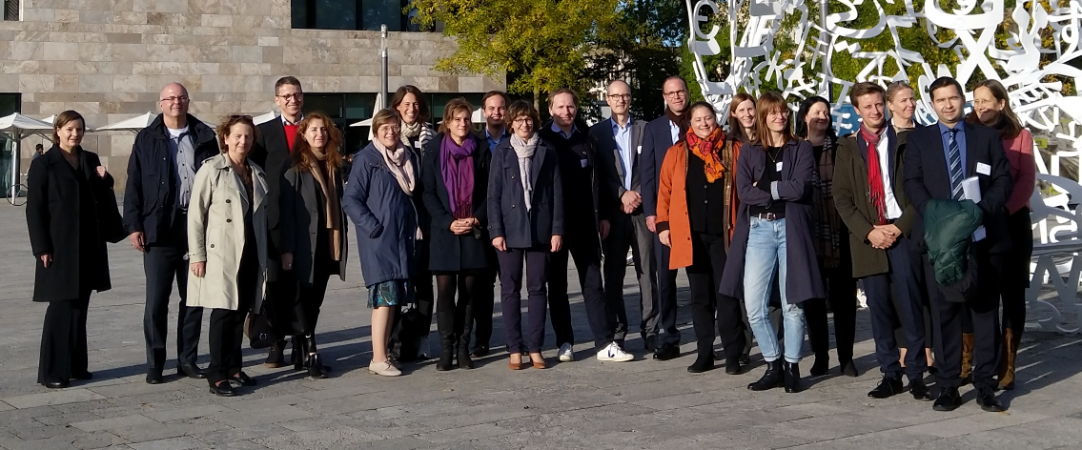
From 11-13 October, the Policy Fellows of the new cohort visited the Rhine-Main Universities for the first time. On the afternoon of 11 October, Tome Sandevski (Head of the Fellowship Programme) introduced the programme. After the introduction, the Policy Fellows were able to present their thematic interests in small groups to the other participants and thus already got an overview of the other Fellows' areas of interest. During a campus tour the fellows could then visit the Campus Westend of Goethe University Frankfurt.
The Fellows were given an initial overview of the research areas at the Rhine-Main Universities during the evening event. After introductory words by Vice-President Prof Christiane Thompson (Goethe University), the Fellows Torsten Klimke (Directorate-General Mobility and Transport of the European Commission) and Dr. Kerstin Wendland (Federal Ministry for Family Affairs, Senior Citizens, Women and Youth) discussed with Prof Nathalie Behnke (Political Science, TU Darmstadt), Prof Verena Brinks (Geography, Johannes Gutenberg University Mainz) and Prof Jan Pieter Krahnen (Economics, Goethe University Frankfurt) the question of how the dialogue between practice and science could be improved in times of crisis. The Deputy Head of Research Support at Goethe University Frankfurt, Dr Simone Haasler, was chair of this panel discussion.
On 12 October, the fellows had almost 70 meetings with researchers in Frankfurt and then on 13 October further meetings mainly in Darmstadt and Mainz. This visit ended with the opportunity to participate in the practical forum "Communicating Crisis Knowledge" of the Research Intiative CONTRUST of Goethe University Frankfurt.
20.-21.09.2022
On 20-21 September 2022, the Hessian Ministry of the Environment, the Bund/Länder Arbeitsgemeinschaft Chemikaliensicherheit (BLAC) and the Mercator Science-Policy Fellowship-Programme of the Rhine-Main Universities hosted the "Chemicals Policy in Dialogue" Congress on the Westend Campus of Goethe University Frankfurt. During the congress, representatives from ministries, trade associations, companies, science and civil society discussed current challenges. Prof Werner Brack (Biology, Helmholtz Centre for Environmental Research and Goethe University Frankfurt), Prof Nina Janich (German Studies, TU Darmstadt), Prof Joachim Curtius (Experimental Atmospheric Research, Goethe University Frankfurt) and Prof Henner Hollert (Biology, Goethe University Frankfurt) participated in the event on behalf of the Rhine-Main Universities.
14.-15.09.2022
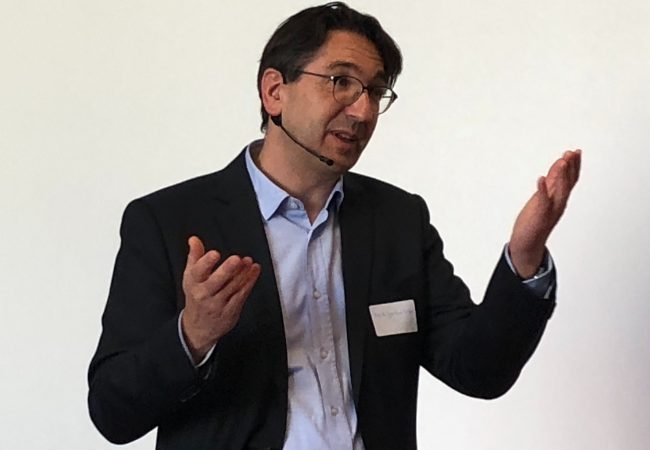
A delegation of 24 researchers and university management staff from the Rhine-Main Universities visited Brussels from 14-15 September 2022. The delegation's visit aimed to raise awareness of funding strategies and cooperation opportunities with EU institutions, while at the same time increasing the visibility of the scientific expertise of the Rhine-Main Universities with EU institutions in Brussels.
On 14 September, the Hessian Representation in Brussels welcomed the delegation and, in cooperation with the Rhine-Main Universities, hosted a internal workshop and a public panel discussion. After the welcome by the State Secretary for Europe, Mr. Uwe Becker, Alison Imrie (Directorate General for Research and Innovation of the European Commission) presented the strategic plans and work programmes under Horizon Europe. Emanuela Bellan and Julian Keimer presented the work of the Joint Research Centre of the European Commission, the cooperation opportunities with research institutions and the activities at the interface between science and policy advice. Two fellows of the Mercator Science-Policy Fellowship Programme, Zuzana Gentner-Vavroa (Directorate General Internal Market of the European Commission) and Manfred Rosenstock (Directorate General Environment of the European Commission), reported on the topics of contributing scientific expertise to legislative procedures as well as strategic foresight and the current work programmes.
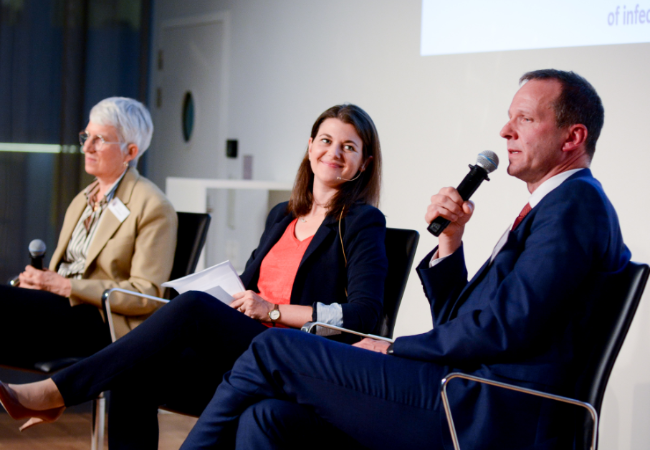
The afternoon workshop was followed by a public event with three panel discussions. After welcoming addresses by State Secretary Becker and Prof Constantin A. Rothkopf, the first panel discussion was dedicated to the topic of challenges and breakthroughs in infectious disease research. Katja Neubauer (Directorate General for Research and Innovation of the European Commission) and Prof Volkhard Kempf (Director of the Institute for Medical Microbiology and Hospital Hygiene, University Hospital, Goethe University Frankfurt) addressed current funding strategies and, in particular, the danger posed by antibiotic-resistant germs.
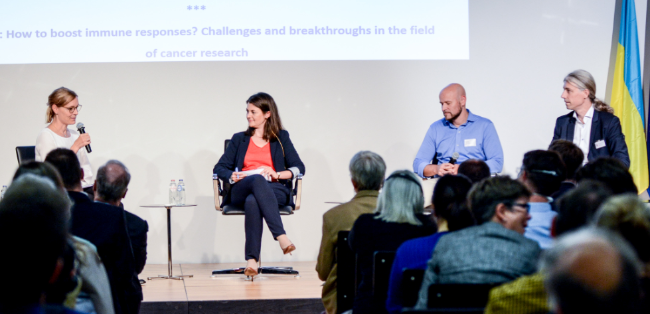
On the second panel, Annika Nowak (DG Research and Innovation of the European Commission), Prof Tobias Bopp (Director of the Institute of Immunology, University Hospital, Johannes Gutenberg University Mainz) and Prof Nico Bruns (Head of the Sustainable Polymers Research Group, Department of Chemistry, Technical University Darmstadt) discussed current challenges and breakthroughs in cancer research.
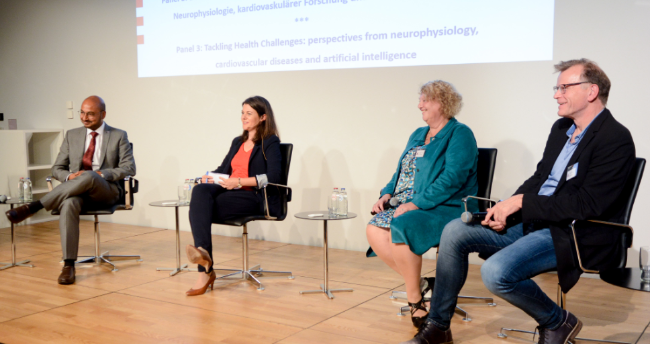
In the third panel, Prof Ingrid Fleming (Director, Institute for Vascular Signalling, University Hospital, Goethe University Frankfurt), Dr Anirban Mukhopadhyay (Head of the Research Group Medical & Environmental Computing (MEC-Lab), Technical University Darmstadt), Prof Jochen Roeper (Director of the Institute for Neurophysiology and the Centre for Physiology, University Hospital, Goethe University Frankfurt) gave insights into their current research projects in the fields of neurophysiology, cardiovascular research and AI.
The three panels were very competently moderated by the journalist Lucia Schulten. With almost 150 visitors from EU institutions, state representations, media organisations and other institutions, the evening event met with great interest.
On 15 September, the delegation visited the Brussels office of the "Kooperationsstelle EU der Wissenschaftsorganisationen" (KoWi). In two workshops on the European Commission's Cancer Mission with Annika Nowas and EU funding measures in the social sciences, humanities and psychology, the members of the delegation were able to exchange views on current funding strategies. Sebastian Claus, Victoria Reichl and Mareike Schmitt provided information about the support offered by KOWI.
The Mercator Science-Policy Fellowship-Programme of the Rhine-Main-Universities conducted the virtual event:
Researchers and policy professionals took stock of regulatory efforts and their effects on businesses in Europe.
Panelists:
02.06.2022
On 2 June 2022, the research focus "Interdisciplinary Public Policy" (IPP) of Johannes Gutenberg University Mainz organised the symposium "Science meets Policy" in cooperation with the Mercator Science-Policy Fellowship Programme of the Rhine-Main Universities on the campus in Mainz.
The programme can be found here.
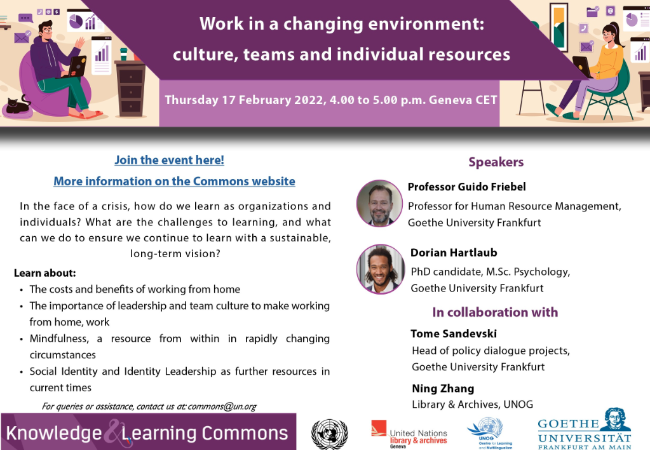
Researchers from Goethe University together with UN professionals discuss the challenges associated with working in a changing environment
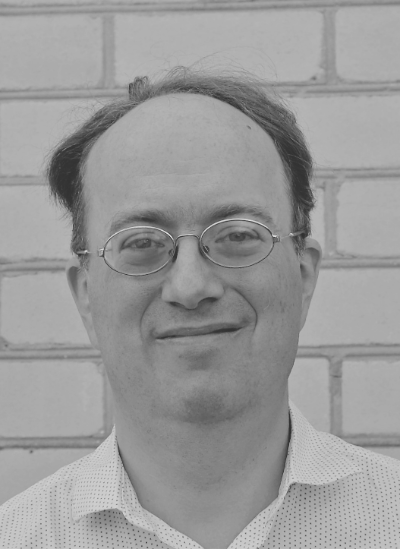
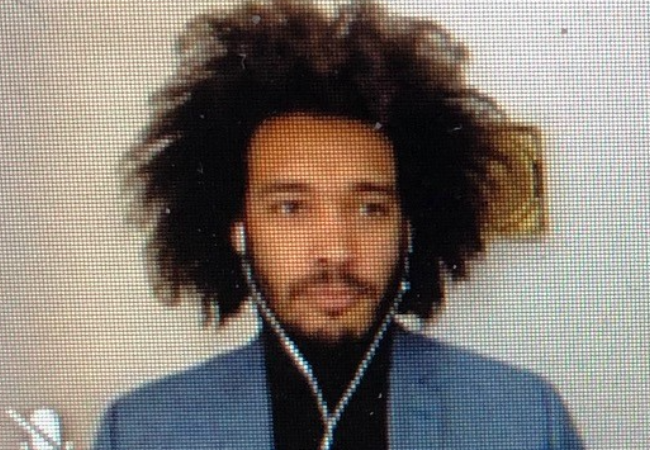
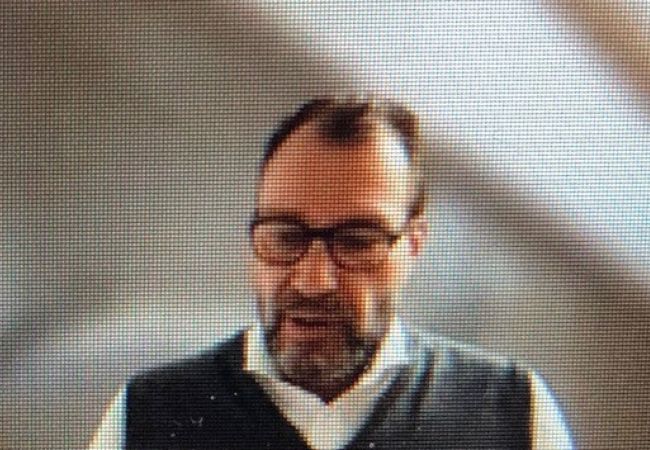
Professor Guido Friebel (Human Resource Management) and Dorian Hartlaub (Psychology) from Goethe University's Center for Leadership and Behavior in Organizations were invited by the Knowledge & Learning Commons of the United Nations Geneva to conduct a webinar on what we have learned in and from times of crisis. The virtual event was attended by over 25 professionals from the UN organisations as well as fellows of the Mercator Science-Policy Fellowship-Programme.
Professor Friebel presented findings from recent research on how the Covid-19 pandemic has affected working from home and the role of leadership by managers and colleagues. “The pandemic has changed the way organisation are operating in a profound way. Much of my research in the field is done in collaboration with various organisations. The UN are very diverse in terms of activities, global outreach and background of staff. Hence, talking to UN staff has been a particularly enriching experience", he shared.
Dorian Hartlaub was also very enthusiastic about the webinar. “I want my research to have an impact in the real-world. This especially applies to staff of organisations like the UN, who are dealing with essential issues like health provision, pace-building or fighting inequality in their daily work. Raising awareness on current demands and on how mindfulness and social aspects of leadership may help to face those demands, is a great opportunity to make that impact", he said.
A video recording of the event is available here. The event was organised by the Knowledge and Learning Commons of the United Nations Geneva in cooperation with Goethe University Frankfurt's Center for Leadership and Behavior in Organizations and the Mercator Science-Policy Fellowship-Programme of the Rhine-Main-Universities.
The European Green Deal aims to transform the EU into a modern, resource-efficient economy that reduces net emissions to zero by 2050 while at the same time ensuring economic growth and improving people`s health. Research and innovation are key prerequisites for tackling the challenges that come with these goals.
In this context, it is crucial to think about climate change in a multidisciplinary and interdisciplinary way. Likewise, a successful climate policy requires that climate and environmental protection be approached as a central cross-sectional task of government. It is imperative that ecology, economics, and social justice be looked at together. Rigorous research must provide the evidence to back new policy approaches.
The Mercator Science-Policy Fellowship Programme of the Rhine-Main Universities (RMU) and the Representation of the State of Rhineland-Palatinate to the European Union cordially invite you to discuss the various perspectives and approaches to the topic with researchers in small online working groups.
Welcome address
Dr. Deniz Alkan,
Director for European and International Affairs; State Chancellery Rhineland-Palatinate
Professor Stefan Müller-Stach,
Vice-President for Research and Research Careers, Johannes Gutenberg University Mainz
Small online working groups
Participating professors
from the Johannes Gutenberg University Mainz:
Petra Ahrweiler (Sociology of Technology and Innovation),
Eva Maria Griebeler (Ecology and Evolution),
Volkmar Wirth (Theoretical Meteorology and Atmospheric Physics);
from the Goethe University Frankfurt:
Joachim Curtius (Experimental Atmospheric Research), and
from the Technical University Darmstadt:
Markus Lederer (Political Science)
An overview on the participating experts and their key messages is available below.
The event is structured around two breakout sessions of 40 minutes each that allow for discussions in small groups. Each professor will have his or her own breakout session that policy professionals can join. After 40 minutes of discussion, the policy professionals will move to a different breakout session. Each participant will therefore have the opportunity to ask questions and discuss policy challenges related to climate change, sustainability, and innovation in two breakout-sessions. This setup will enable the participants to become acquainted with different scientific perspectives.
(1) Addressing climate change requires the development of new technologies. Technological innovation should always be understood as a social transformation process.
(2) Finding sustainability strategies and preventing uncontrollable climate change are not only European but global challenges. Above all, taking into account the different underlying societal value systems is crucial to finding solutions.
(3) Every political decision changes society in ways that cannot be foreseen. For example, a measure to reduce CO2 emissions in a complex societal context may produce a fundamentally different outcome than anticipated. Simulation methods allow different measures to be tested and possible scenarios in a sandbox society to be analysed.
(1) To limit climate change to the targets of the Paris agreement most of the known fossil resources have to remain underground. This means that all oil, gas, and coal companies will have to abandon their business models within the next 2-3 decades and forego a large share of their already calculated profits. European politics and legislation will be largely preoccupied with making this happen in the EU and worldwide.
(2) By significantly reducing meat production, huge agricultural areas that are currently used for growing animal feed will become available for rewetting marschlands, reforestation, and solar farming. This means less methane from cows, less CO2 from drained marshlands, more biodiversity, more carbon uptake, and more renewable energy production.
(3) The non-CO2 climate effects of aviation are greater than its CO2 effects from burning kerosine. These non-CO2 effects from persistent contrails and ozone production have to be included in the ETS system. Most of these effects will remain even if aviation changes to hydrogen or sustainable aviation fuels. This means that it is highly questionable as to whether sustainable aviation can be reached at all.
(1) We are currently facing a serious biodiversity crisis caused by the increase in the human population and economic growth. The first Global Assessment on Biodiversity and Ecosystem Services (IPBES report 2019) reports that about one eighth of animal and plant species living on earth are already endangered. This is mainly due to the overexploitation of nature, accompanying habitat loss and fragmentation, pollution, climate change, the commercial depletion of species, and the expansion of exotic species.
(2) Biodiversity and functional ecosystems are essential for humans. Ecosystems with their species provide many important services to humans. For example, they provide the air we breathe, drinking water, food, medical plants, and building materials.
(3) Although we are far from understanding how the loss of species affects the functioning and long-term stability of our ecosystems, we are already experiencing its consequences and we must respond. The establishment of protected and restored areas, stopping habitat destruction as well as reducing contaminants from industry, agriculture, and settlements will counteract the ongoing species decline. A sustainable use of nature at the societal and individual level and a shrinking world population will decrease the overexploitation of nature and mitigate climate change and other threats to biodiversity to maintain functional and stable ecosystems for future generations.
(1) Dealing with climate change is a highly complex task and there are no silver bullets. On the contrary, economic and technical interventions often have negative social or political consequences that have to be taken into account. The earlier and more openly this is done, the more legitimate and eventually effective policies will evolve. The EU's Green Deal is a first, very first, step in this direction.
(2) There is no solution to the climate problem or to many environmental crises without including the most important emerging economies and eventually the global South as a whole. This has changed the structure of world politics and requires the active engagement of the EU and its member states in global climate politics on all levels and with various governmental and non-governmental actors. But the EU and its members cannot just lead by example; they will have to invest heavily in mitigation and adaptation programs in the global South. Climate policy must therefore become part of the EU's foreign policy and foreign economic policy.
(3) Within many countries of the global South, climate and environmental policies will be successful only if a new and more responsive institutional setup is put into place. This requires state- and institution-building and very often entails a strengthening of national administrative systems. For example, if the EU really wants to stop deforestation in Indonesia, not only will its citizens have to change their consumption patterns, but Indonesia will also have to change the way its bureaucracy works.
(1) It is beyond any reasonable scientific doubt that humans have changed the climate on earth through greenhouse gas emission. This climate change is practically irreversible and will become much more severe in the future if the emission of greenhouse gases is not phased out very quickly.
(2) Anthropogenic climate change materialises through, among other things, a strongly enhanced frequency of extreme events (such as heat waves and heavy precipitation). Such weather extremes will be an increasing problem for human society, health, and the economy. The cost incurred by these man-made problems may soon outweigh the cost of decarbonizing the world economy.
(3) The climate system contains so-called tipping points, which means that passing a certain threshold in global warming will irreversibly push a number of climate subsystems into a new state that human society has not yet experienced. The likelihood of passing such thresholds increases with rising temperatures, and this, again, calls for fast decarbonization.
(4) There are open questions regarding the change of the atmospheric circulation that need to be settled. However, these remaining uncertainties do not detract at all from the urgent need for fast action motivated by the well-established facts formulated in items (1)-(3).